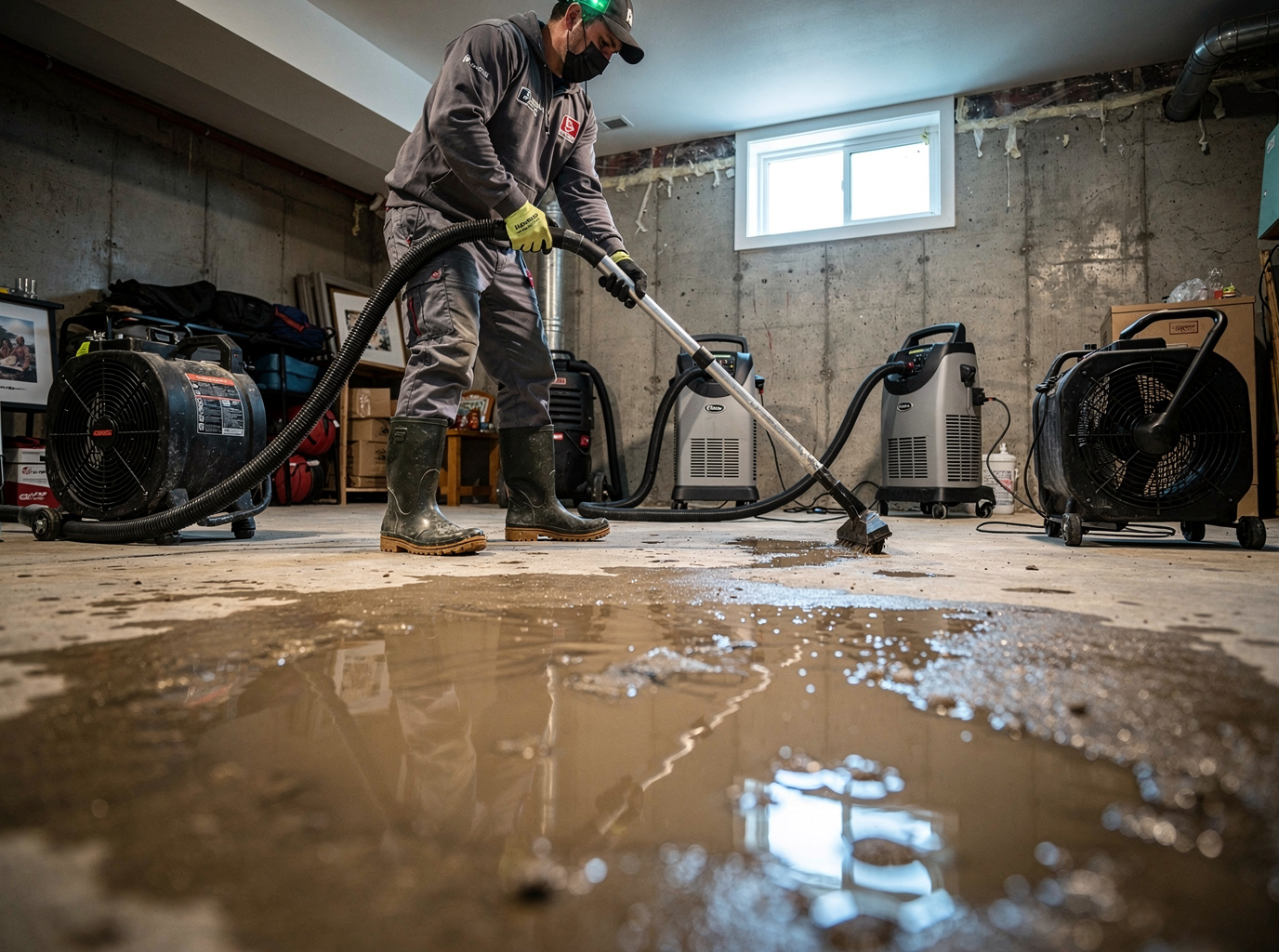
Basements in Austin flood for reasons that surprise a lot of homeowners — it's not always a burst pipe. We see foundation seepage after the ground shifts from our clay-heavy soils drying out and cracking in summer then swelling with fall rains, sump pump failures during the sudden downpours that hit neighborhoods near Barton Hills and Zilker, and grading issues that funnel runoff toward homes in older sections of Travis Heights and Clarksville where lots slope oddly. Whatever the cause, standing water in a basement or below-grade room needs to come out fast because unlike an upstairs leak, gravity keeps it pooled against your foundation walls and slab, and it wicks into drywall, insulation, and framing far quicker than most people expect.
The biggest mistake we see homeowners make is waiting to call because the water looks 'just a couple inches.' Category 2 or 3 water — anything that's touched soil, backed-up sewage, or sat for more than 24-48 hours — carries contamination risk that isn't visible to the eye. In Austin's heat and humidity, especially through our long summer stretch, mold colonies can establish on wet drywall and framing within 24-72 hours. That timeline gets even tighter in a basement because airflow is naturally poor and ambient moisture has nowhere to escape without mechanical dehumidification.
There are also structural considerations specific to older Austin homes, particularly around East Austin, Hyde Park, and Mueller, where some basements or crawl-adjacent spaces were built with materials and drainage details that don't meet current code. If we find inadequate perimeter drainage, missing vapor barriers, or a sump system that's undersized for the lot's runoff, we'll flag it — fixing the water damage without addressing the underlying drainage problem just means we'll be back in six months. We coordinate with plumbers and foundation specialists when the flood cleanup uncovers a bigger issue than surface water.
Insurance claims for basement flooding are often more complicated than upstairs water losses because adjusters look closely at the source. Sudden pipe failures are usually covered; long-term seepage or grading-related flooding often isn't, or falls under a separate endorsement. We document everything — moisture readings, photos, extraction logs — from the first visit so you have what you need regardless of how the claim shakes out.
Basement Flood Cleanup Services We Offer
✓Emergency Water Extraction
Truck-mounted and portable extraction to pull standing water out fast, minimizing how far it travels into walls and stored belongings.
✓Structural Drying & Dehumidification
Industrial air movers and dehumidifiers set to Austin's summer humidity levels to dry framing, subfloor, and drywall before mold takes hold.
✓Sewage Backup Cleanup
Safe removal and sanitizing of contaminated (Category 3) water from sewer backups or groundwater intrusion, with contaminated materials disposed of properly.
✓Mold Prevention Treatment
Antimicrobial application on affected framing and surfaces after drying, aimed at stopping growth before it starts rather than remediating it later.
✓Damaged Material Removal
Tear-out of soaked drywall, baseboards, carpet, and insulation that can't be dried in place, prepping the space for rebuild.
✓Sump Pump & Drainage Assessment
Evaluation of existing sump systems and perimeter drainage to identify why water got in, with referrals to trusted plumbers when repairs are needed.
✓Content Pack-Out & Drying
Removal, drying, and inventory of stored items, furniture, and belongings affected by the flood so they can be assessed for salvage.
Basement Flood Cleanup Cost in Austin, TX
| Service | Typical Range | What Affects It |
|---|---|---|
| Water Extraction (Small Basement, Clean Water) | $300–$800 | Depth of standing water and square footage affected |
| Structural Drying & Dehumidification | $500–$2,000 | Number of days equipment runs and how saturated framing/subfloor is |
| Category 3 Sewage/Contaminated Water Cleanup | $1,000–$4,000+ | Higher labor and disposal costs for contaminated materials |
| Drywall & Insulation Tear-Out | $3–$8 per sq ft | Height of water line and whether insulation must also be removed |
| Mold Prevention Treatment | $200–$600 | Square footage treated and severity of moisture exposure |
| Content Pack-Out & Drying | $300–$1,500 | Volume of belongings and whether specialty drying is needed |
Ranges are typical for Austin, TX and confirmed with an exact written quote before any work starts.
How it works
- 1
Emergency Response
We answer 24/7 and get a crew moving right away — the first hours after a basement flood determine how much of the structure and contents can be saved.
- 2
Assessment & Water Categorization
We identify the water source, test its contamination level, and map how far moisture has traveled using moisture meters and thermal imaging.
- 3
Extraction & Tear-Out
Standing water gets pumped out, then any drywall, insulation, or flooring that can't be salvaged is removed to expose the framing underneath.
- 4
Drying & Sanitizing
Air movers and dehumidifiers run until moisture readings confirm the space is dry, with antimicrobial treatment applied to prevent mold.
- 5
Documentation & Rebuild Coordination
We provide detailed records for your insurance claim and coordinate rebuild work or drainage repairs if the root cause needs fixing.
Pricing
Most basement flood jobs run a few hundred to several thousand dollars depending on water depth, contamination level, and how much material needs tearing out — we give an upfront quote after the initial assessment, before any work starts.