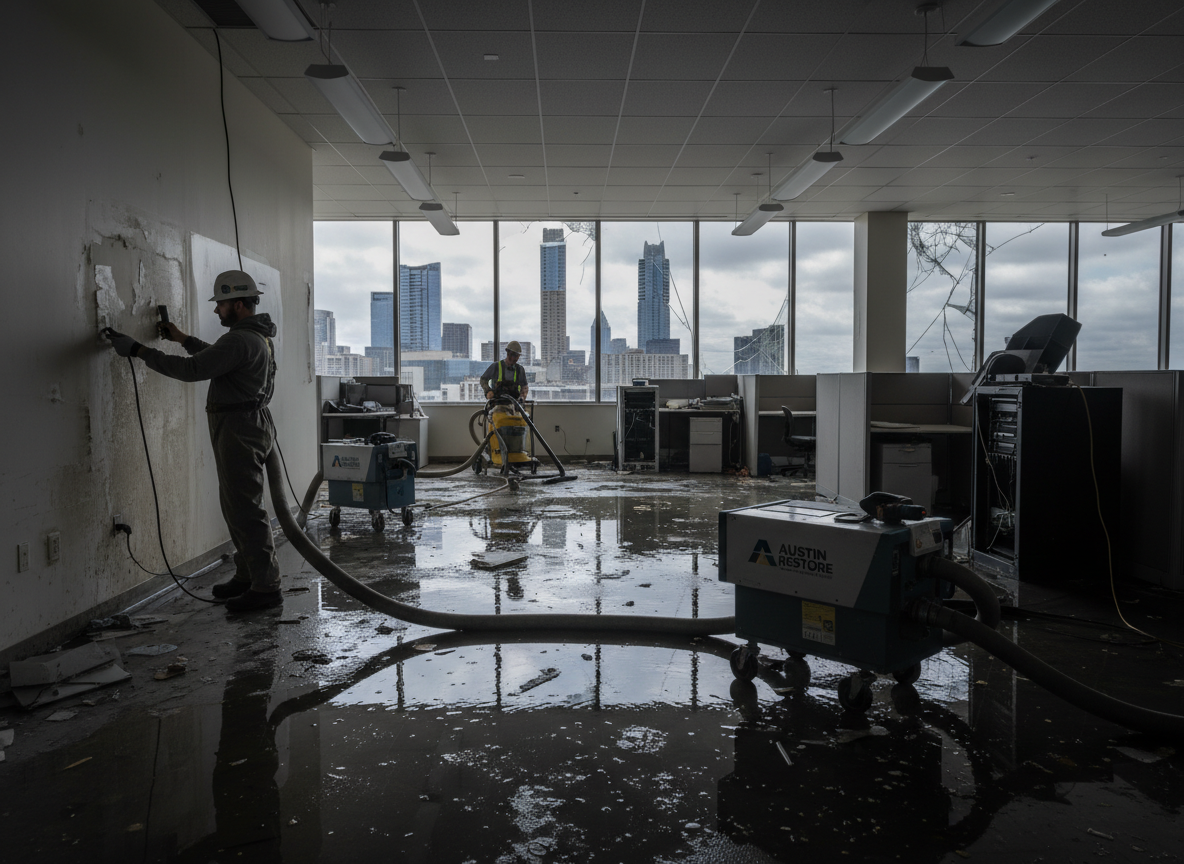
Commercial buildings flood differently than houses, and that changes everything about the response. A burst supply line on the third floor of a downtown office tower can travel through electrical chases and drop ceilings, soaking suites two floors below before anyone notices. Retail spaces on South Congress with polished concrete or engineered wood over slab need moisture mapping before any demo starts, because trapped water under a vapor barrier can wick for weeks and delaminate flooring long after the surface looks dry. We treat every commercial call as a multi-trade coordination job, not just a water pickup.
Building type drives the plan. A restaurant kitchen with grease-laden runoff needs different containment and disposal than a medical office with sensitive equipment and compliance concerns around mold and air quality. Multi-tenant properties around the Domain-style build or older brick structures in East Austin often have shared HVAC returns, so airborne moisture and odor spread to units that never took on water — we test and dry those adjacent spaces too, not just the source unit. Insurance carriers and property managers expect documentation at every step, so we photograph, moisture-map, and log drying progress daily for the claim file.
Class 4 water intrusion — water trapped in hardwood, plaster, brick, or concrete common in older Austin commercial buildings near Clarksville and Hyde Park — takes longer to dry and often needs specialty low-grain-refrigerant equipment and injection drying systems, not just standard air movers. Skipping this step is the most common mistake we see from rushed jobs: surfaces test dry on day three, but moisture wicking up through masonry keeps feeding mold behind walls for months. We also flag when a slab needs core drilling versus surface drying, since guessing wrong wastes days of downtime a business can't afford.
Business interruption is the real cost driver, more than the materials. Our priority on any commercial loss is stopping the water, protecting inventory and equipment, and getting occupied areas dried and cleared fast enough that a business can keep operating in unaffected zones while we work the damaged section. We work around your hours when we can, but we're available around the clock because a pipe doesn't wait for business hours and neither do we.
Commercial Water Damage Restoration Services We Offer
✓Emergency Water Extraction
Truck-mounted and portable extraction to pull standing water fast from offices, retail floors, and basements before it spreads further.
✓Commercial Structural Drying
Engineered drying plans using air movers, dehumidification, and moisture monitoring sized for large square footage, not a residential setup stretched thin.
✓Ceiling & Drop-Tile Repair
Repair or replacement of water-damaged suspended ceilings and grid systems common in office buildouts and retail spaces.
✓Flood Damage Repair
Cleanup and rebuild after flash flooding or overflow near Lady Bird Lake and low-lying areas of Travis County, including contaminated water protocols.
✓Document & Server Room Recovery
Specialized drying and stabilization for areas with electronics, paper records, or IT equipment where standard drying methods risk further damage.
✓Multi-Tenant Building Restoration
Coordinated drying and repair across shared walls, HVAC returns, and common areas so one unit's leak doesn't become a building-wide mold problem.
✓Post-Restoration Reconstruction
Drywall, flooring, and trim rebuild once drying is verified, getting the space back to a leasable or operational condition.
✓Insurance Claim Documentation Support
Moisture logs, photos, and drying reports formatted for property managers and adjusters handling commercial claims.
Commercial Water Damage Restoration Cost in Austin, TX
| Service | Typical Range | What Affects It |
|---|---|---|
| Emergency Extraction (per visit) | $500–$2,500 | Depends on square footage and depth of standing water |
| Structural Drying Setup | $1,500–$6,000 | Varies with number of rooms, equipment count, and drying days needed |
| Ceiling Tile & Grid Repair | $3–$8 per sq ft | Grid damage and material grade affect cost |
| Flood Damage Cleanup | $2,000–$10,000+ | Contaminated water requires more containment and disposal steps |
| Full Reconstruction (post-drying) | Varies by scope | Depends on drywall, flooring, and finish level required |
Ranges are typical for Austin, TX and confirmed with an exact written quote before any work starts.
How it works
- 1
Emergency Response & Assessment
We arrive, shut off or contain the water source if needed, and moisture-map the affected areas including adjacent units and above/below floors.
- 2
Extraction
Standing water is removed with commercial-grade equipment sized to the space, prioritizing high-value areas like server rooms or inventory storage.
- 3
Drying & Monitoring
Air movers and dehumidifiers are placed per a drying plan specific to your materials — concrete, hardwood, drywall — with daily moisture readings logged.
- 4
Repair & Reconstruction
Once materials test dry, we handle drywall, flooring, ceiling tile, and trim repairs to bring the space back to operational condition.
- 5
Final Walkthrough & Documentation
We hand over a complete drying and repair record, useful for your insurance claim or property management file.
Pricing
Commercial jobs are priced by square footage, water category, and how many trades are needed — we give a written estimate after the initial assessment, not a phone quote.