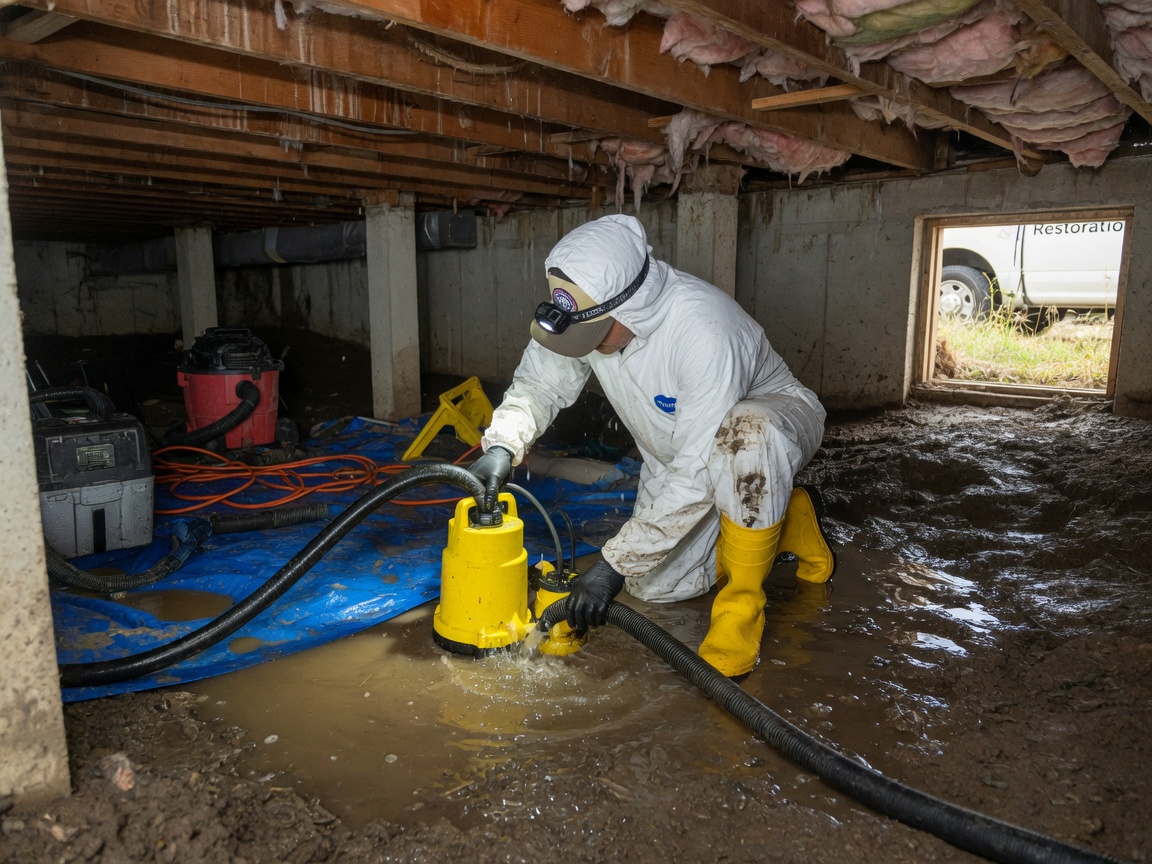
Austin's older neighborhoods — Travis Heights, Clarksville, Hyde Park — are full of pier-and-beam homes with open crawl spaces that sit low relative to grade. When a hard spring rain hits or a supply line under the house lets go, water pools against the piers and soaks the subfloor insulation before anyone notices. We've pulled soggy fiberglass batts out of crawl spaces that had been wet for weeks because the access hatch was hidden behind a shed. By the time you smell it, the joists are usually already staining.
The bigger risk in a hot, humid Austin summer isn't the standing water itself — it's what grows after. Crawl spaces trap moisture and heat, and mold colonies can establish on floor joists and duct insulation within 48–72 hours of a flood event. We pull the water first with submersible pumps and wet vacs rated for confined spaces, then run negative-air drying with axial fans and desiccant dehumidifiers to pull ambient humidity down before organic growth gets a foothold. Skipping the drying step and just extracting water is the most common shortcut we see from other crews, and it's why homeowners call us back a month later with a mold problem.
Vapor barriers matter more here than people think. A lot of homes near Barton Hills and Mueller were built or renovated with 6-mil poly laid loose over dirt, and once it floods, the barrier traps water underneath it instead of blocking ground moisture — we have to pull it, dry the soil, and reinstall or replace it. If your crawl space has exposed HVAC ductwork or electrical junction boxes down there, we treat those as priority-one hazards; wet insulation on ducts gets cut out and replaced, and we won't run drying equipment near a live junction box until it's been checked.
Flood damage in a crawl space also raises structural questions no one wants to deal with: are the floor joists still sound, is there termite damage hiding under the old moisture, has the sill plate wicked water up into the wall framing? We document all of this with photos before starting any drying work, both for your insurance claim and so you know exactly what you're paying to fix versus what's cosmetic.
Crawl Space Water Removal Services We Offer
✓Emergency Crawl Space Water Extraction
Submersible pump and wet-vac extraction for active flooding under the house, dispatched 24/7 when a pipe bursts or storm runoff backs up.
✓Standing Water & Sump Pump Removal
For crawl spaces that chronically pond after heavy rain, we install or repair a sump pit and pump system to keep water from returning.
✓Vapor Barrier Removal & Replacement
We pull saturated poly sheeting, dry the soil beneath, and install new heavy-mil vapor barrier to keep ground moisture from wicking back up.
✓Wet Insulation Removal
Soggy fiberglass or foam board insulation gets stripped and hauled out before it becomes a mold reservoir under your subfloor.
✓Crawl Space Structural Drying
Axial air movers and dehumidifiers targeted at joists, subfloor, and sill plates to bring wood moisture content back to a safe range.
✓Mold Prevention Treatment
Antimicrobial application on wood framing after drying to stop mold from establishing on joists and beams post-flood.
✓Flood Damage Assessment for Insurance
Photo-documented moisture readings and damage notes formatted for your Travis County homeowners claim before repairs start.
Crawl Space Water Removal Cost in Austin, TX
| Service | Typical Range | What Affects It |
|---|---|---|
| Emergency water extraction (small crawl space) | $300–$800 | Depends on standing water depth and access difficulty |
| Structural drying (equipment + monitoring) | $400–$1,200 | Length of dry-out and square footage of crawl space |
| Vapor barrier replacement | $500–$1,500 | Total crawl space square footage and soil condition |
| Wet insulation removal & replacement | $600–$2,000 | Type of insulation and extent of soaking |
| Sump pump installation | $800–$2,200 | Pit depth, pump capacity, and discharge line routing |
| Mold prevention treatment | $250–$700 | Square footage of exposed framing treated |
Ranges are typical for Austin, TX and confirmed with an exact written quote before any work starts.
How it works
- 1
Access & Assess
We get into the crawl space through the access hatch or a temporary cut if needed, and check depth of standing water, source, and any electrical/HVAC hazards before pumps go in.
- 2
Extract Water
Submersible pumps and wet vacs remove standing water; we track where it's pooling against piers so we know if drainage grading needs attention too.
- 3
Remove Damaged Materials
Saturated insulation, ruined vapor barrier, and any debris get pulled out — leaving them in place just slows drying and feeds mold.
- 4
Dry & Monitor
Air movers and dehumidifiers run until moisture meter readings on the joists and subfloor come back to normal range, not just until it 'looks dry.'
- 5
Restore & Prevent
New vapor barrier and insulation go back in, antimicrobial treatment is applied to framing, and we flag any grading or plumbing fixes that will prevent a repeat.
Pricing
Most crawl space water jobs in Austin run a few hundred to a few thousand dollars depending on water depth, square footage, and whether insulation and vapor barrier need full replacement — we give you a written number after the initial inspection, not before.