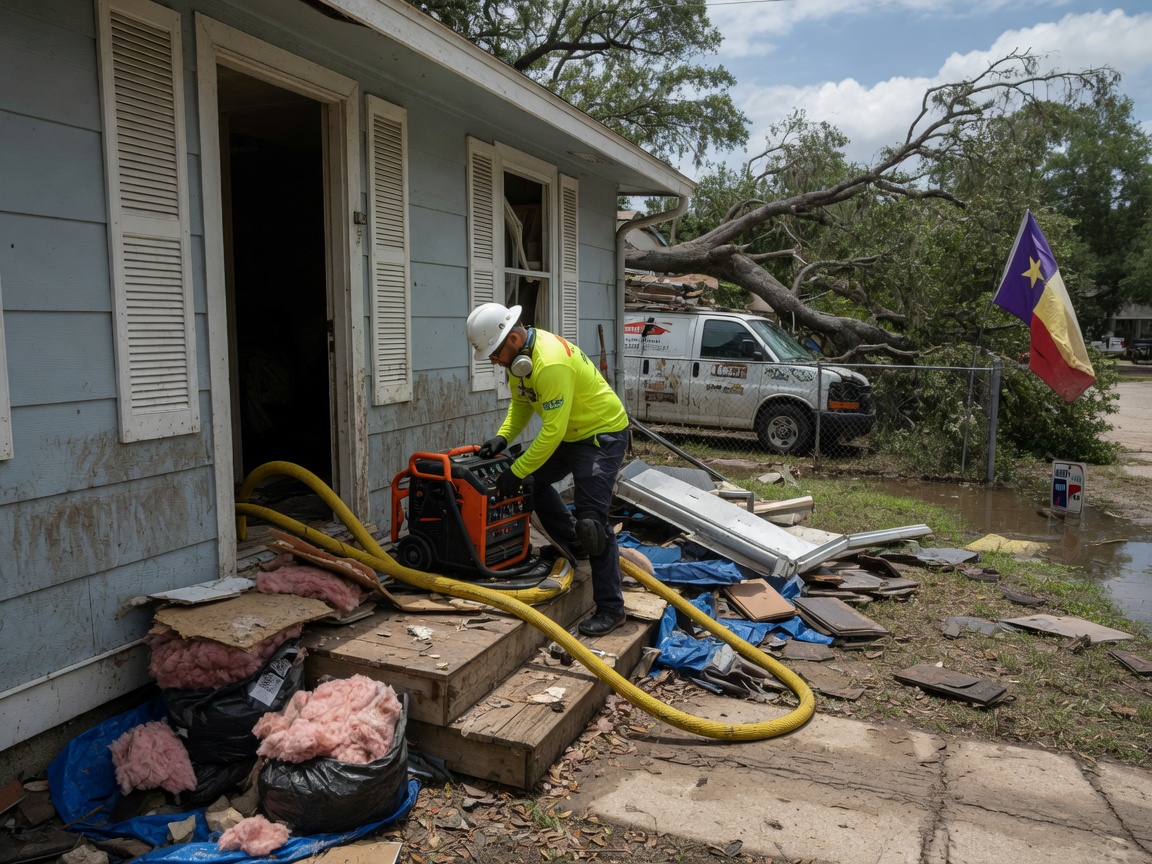
Austin doesn't take a direct hurricane landfall, but we absolutely take the fallout. When a Gulf system stalls over Central Texas or a tropical remnant dumps eight inches of rain in an afternoon, Travis County floods fast — Lady Bird Lake rises, Barton Creek jumps its banks near Zilker Park, and low-lying stretches of South Congress and East Austin see water pushing into slab foundations and garages within hours. We've pulled soaked drywall out of houses in Travis Heights the same week a storm made landfall three hundred miles away on the coast. The damage pattern is different from a plumbing leak: it's widespread, it hits multiple rooms at once, and it often arrives with wind-driven rain that's already found its way behind siding and through roof flashing before the flooding even starts.
The biggest mistake homeowners make after a tropical storm event is waiting to see if things 'dry out on their own' because the sun comes back out fast in Austin's humid climate — but that same humidity is exactly why materials stay wet longer than people expect and mold colonies establish within 48–72 hours. We check moisture content in framing, subfloor, and drywall with meters, not guesswork, and we document everything with photos and moisture logs because most insurance carriers require it for wind-driven rain and flood claims to be processed without a fight.
Older homes in Clarksville, Hyde Park, and near the UT Tower often have plaster-over-lath walls or original hardwood floors that behave very differently under water intrusion than modern drywall and engineered flooring — plaster can look fine and still be structurally compromised, and hardwood needs slow, controlled drying or it cups and buckles permanently. Newer builds in Mueller and parts of Westlake, meanwhile, often have foam insulation and vapor barriers that trap moisture behind walls if you don't open them up, so a quick surface dry-out gives a false sense that the job's done. We adjust the drying strategy to the construction, not the other way around.
One code-related note worth knowing: if flood water (as opposed to clean rainwater) entered living space, most jurisdictions including Travis County treat porous materials — carpet pad, particleboard, insulation that's been submerged — as non-salvageable for health reasons, regardless of how they look once dry. We flag this early so there are no surprises when it's time to talk about what gets replaced versus dried in place.
Hurricane Damage Restoration Services We Offer
✓Storm Flood Water Extraction
Pump and vacuum extraction for homes that took on water from creek overflow, street flooding, or storm surge backup — starting the drying clock before mold gets a foothold.
✓Wind-Driven Rain Intrusion Repair
Tracing and drying out water that entered through roof flashing, window seals, or siding during high-wind rain bands, often the hidden damage behind a storm that looked 'mostly wind.'
✓Structural Drying & Dehumidification
Industrial air movers and dehumidifiers set up to pull moisture out of framing, subfloor, and wall cavities with daily moisture readings until materials hit safe levels.
✓Drywall, Plaster & Flooring Removal
Controlled demolition of water-damaged drywall, plaster, and flooring that's passed the point of safe drying, cut to code height to limit unnecessary rebuild costs.
✓Mold Prevention & Remediation
Antimicrobial treatment during the drying phase, plus full remediation if mold has already started colonizing in the days after a storm before restoration began.
✓Insurance Documentation & Claims Support
Moisture logs, photo documentation, and itemized scope of work built specifically for flood and wind-damage claims so adjusters have what they need the first time.
✓Roof Tarp & Emergency Board-Up
Temporary tarping and board-up on wind-damaged roofs and windows to stop ongoing water intrusion while permanent repairs are scheduled.
Hurricane Damage Restoration Cost in Austin, TX
| Service | Typical Range | What Affects It |
|---|---|---|
| Emergency Water Extraction (per room) | $400–$1,200 | Depends on water depth and how much furniture/flooring must be moved or removed |
| Structural Drying Setup (per day, whole-home) | $300–$800/day | Number of air movers/dehumidifiers needed and typical drying runs 3–5 days |
| Drywall & Insulation Removal | $2–$6 per sq ft | Height of cut, whether insulation and framing also need replacement |
| Mold Remediation (localized) | $500–$3,000 | Size of affected area and whether it spread inside wall cavities |
| Emergency Roof Tarping | $300–$900 | Roof pitch, size of damaged area, and access difficulty |
| Full Flood Restoration Rebuild | $5,000–$25,000+ | Scope of demolition, finish level, and square footage rebuilt |
Ranges are typical for Austin, TX and confirmed with an exact written quote before any work starts.
How it works
- 1
Emergency Response Call
We're answering calls around the clock — a storm doesn't wait for business hours and neither do we. We get basic details and dispatch immediately for active water intrusion.
- 2
Damage Assessment & Moisture Mapping
On arrival we check every affected area with moisture meters and thermal imaging where needed, mapping how far water traveled behind walls and under flooring.
- 3
Extraction & Emergency Mitigation
Standing water gets pumped or vacuumed out, tarps go up on damaged roof sections, and we cut away materials that flood water has already ruined beyond safe drying.
- 4
Controlled Structural Drying
Air movers and dehumidifiers run on a schedule we monitor daily, adjusting placement as materials dry unevenly, which is common in older Austin homes with mixed construction.
- 5
Repair & Rebuild
Once everything reads dry, we rebuild — drywall, flooring, trim — matching existing finishes where possible and handing back a home that's not just dry but repaired.
Pricing
Storms damage every property differently, so we price after seeing the actual water and wind damage — expect a range based on square footage affected, how many days water sat before we got the call, and whether structural materials need replacing versus drying in place.