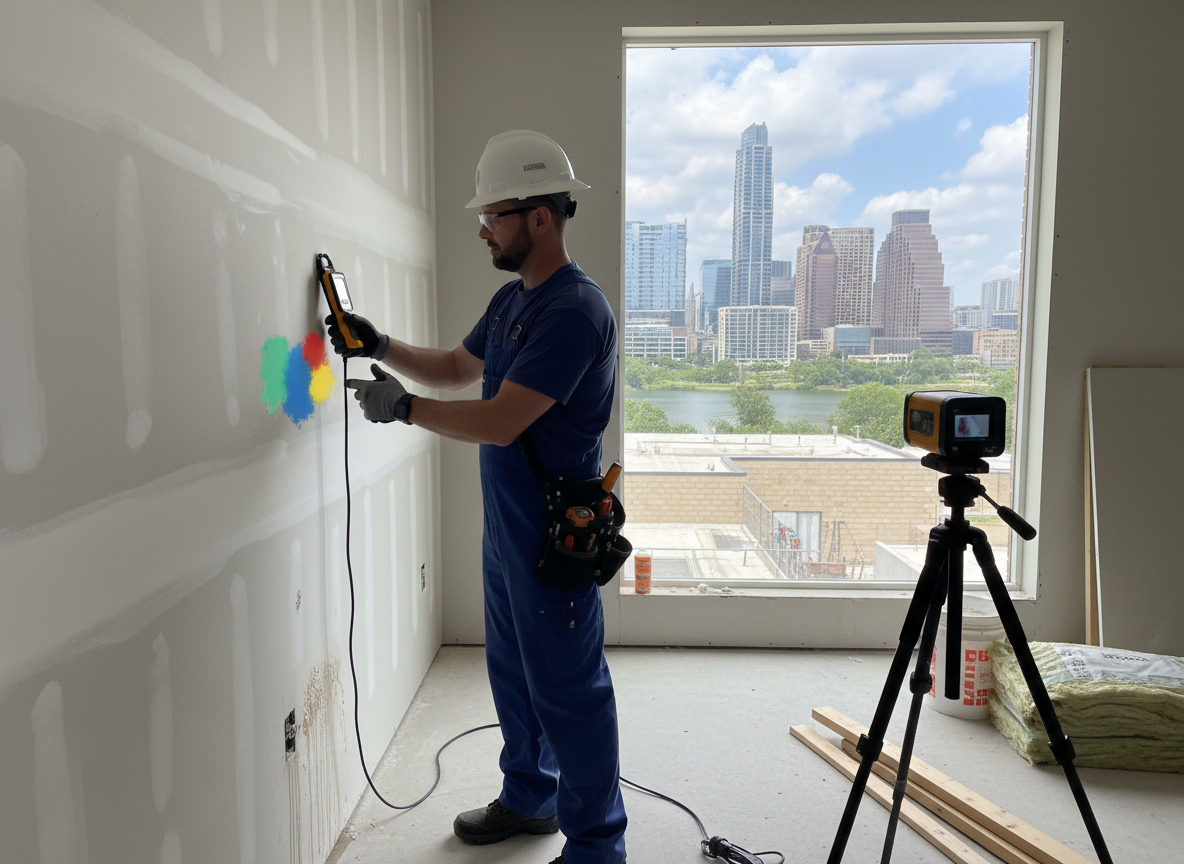
Moisture detection is the part of the job most homeowners never see but that decides whether a repair actually holds. We use non-invasive moisture meters, thermal imaging cameras, and psychrometric readings (temperature plus relative humidity) to map how far water traveled behind drywall, under engineered hardwood, and inside wall cavities. In Austin's older housing stock — a lot of the bungalows in Hyde Park, Clarksville, and Travis Heights were built long before vapor barriers were standard — moisture can wick sideways through plaster and lath in ways a simple surface-scan meter will miss. We always check adjacent rooms, not just the room with visible staining, because gypsum board conducts moisture laterally faster than most people expect.
One edge case we run into constantly: slab foundations combined with Austin's clay-heavy soil. When a slab leak or a supply line failure happens, water doesn't pool visibly — it gets pulled up through the concrete and into baseboards, sometimes 15-20 feet from the actual source. Infrared cameras show the thermal signature of the wet slab, but they don't measure moisture directly, so we always confirm with a pin or pinless meter reading before writing a scope of work. Skipping that step is how contractors end up tearing out drywall in the wrong room and missing the real leak entirely.
Humidity matters as much as visible water. Austin's summers push relative humidity high enough that a building with even a small unresolved leak can sustain elevated wall-cavity moisture for weeks without anyone noticing a drip. We log baseline dry-standard readings from an unaffected area of the same structure, then compare affected readings against that baseline rather than against a generic number — building materials, framing type, and even orientation to the sun affect what 'normal' moisture content looks like in a given house. This baseline approach is also what insurance adjusters expect to see documented in a moisture log, so we build that record from day one of the inspection.
We also flag conditions that go beyond a simple 'dry it out' recommendation. Moisture trapped behind vinyl wallpaper, tile with no vapor-permeable backer, or inside foam insulation cavities can hide sustained wet conditions that never show up on a surface reading. In these cases we recommend limited demolition to inspect framing directly, because sealing moisture inside a wall assembly is one of the most common causes of mold growth going undetected for months, especially in older East Austin and Mueller-area homes with mixed renovation histories.
Moisture Detection Services We Offer
✓Thermal Imaging Inspection
Infrared cameras spot temperature differentials that indicate hidden moisture behind walls and ceilings without cutting into finished surfaces.
✓Moisture Mapping and Documentation
We log room-by-room moisture readings against a dry-standard baseline, producing documentation insurance adjusters and contractors can act on.
✓Slab Leak Moisture Assessment
Pin and pinless meter readings combined with thermal scans to trace how far moisture from a slab leak has migrated into walls and flooring.
✓Hidden Mold Risk Screening
Targeted checks behind wallpaper, tile, and foam insulation where trapped moisture commonly triggers mold growth that isn't visible on the surface.
✓Post-Flood Drying Verification
Follow-up moisture readings after drying equipment runs to confirm materials have actually returned to a safe moisture content before rebuild starts.
✓Pre-Purchase Moisture Inspection
A non-invasive moisture check for buyers or sellers of Austin homes near Lady Bird Lake and other flood-prone corridors before closing.
Moisture Detection Cost in Austin, TX
| Service | Typical Range | What Affects It |
|---|---|---|
| Single-room moisture inspection | $125–$250 | Includes thermal scan and meter readings for one affected area |
| Whole-house moisture mapping | $300–$650 | Scales with square footage and number of rooms scanned |
| Moisture detection bundled with active water damage job | Often included | Rolled into the job scope when we're already on-site for extraction or drying |
| Documentation report for insurance claim | $75–$150 | Added cost if a standalone written report is requested separately from a repair visit |
| Pre-purchase moisture inspection | $150–$300 | Depends on home size and whether crawlspace or attic access is needed |
Ranges are typical for Austin, TX and confirmed with an exact written quote before any work starts.
How it works
- 1
Initial Walkthrough
We assess visible damage, ask about the timeline of the leak or flood event, and identify likely paths water could have traveled through the structure.
- 2
Thermal And Meter Scanning
Infrared imaging finds temperature anomalies; pin or pinless moisture meters confirm actual moisture content at each suspect location.
- 3
Baseline Comparison
Readings from affected areas are compared against a dry-standard baseline taken from unaffected parts of the same building.
- 4
Documentation And Report
We produce a written moisture log with readings, photos, and thermal images — usable for insurance claims or contractor scopes.
- 5
Recommendation
We tell you plainly whether drying equipment, limited demolition, or no action is needed, and what to monitor going forward.
Pricing
Straightforward moisture detection visits are usually inexpensive relative to the repair work they can prevent; pricing depends on square footage and how many rooms need scanning. Ask for an upfront quote before we start.