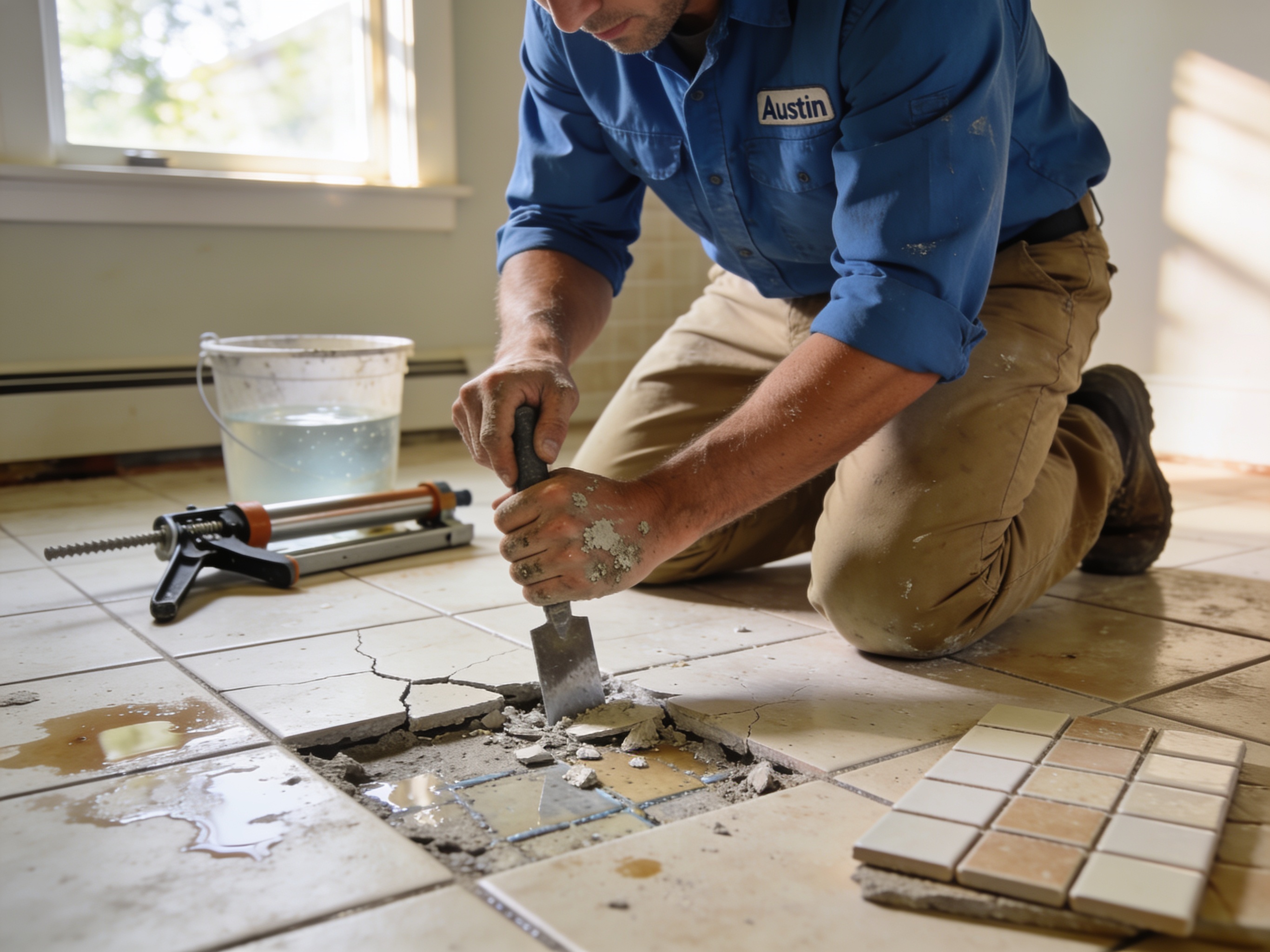
Tile itself doesn't absorb much water, but that's exactly what makes tile floor water damage tricky — the tile can look perfectly fine while the substrate underneath is rotting away. We see this constantly in older Hyde Park and Travis Heights homes where tile was set over plywood subfloor decades ago, versus newer builds near Mueller where it's typically over a concrete slab. Slab-on-grade construction, common across most of Austin, actually handles standing water better than wood subfloor, but it's not immune — water can wick under the tile through grout lines and expansion joints, get trapped, and start growing mold between the slab and the thinset within 24-48 hours, especially in our humid summer months.
The tell-tale signs we look for are hollow-sounding tiles when tapped, grout lines that have discolored or crumbled, tiles that have popped loose or shifted, and a musty smell that persists after the surface water is gone. We use moisture meters and sometimes a thermal camera to map how far water traveled laterally under the tile field — it's rarely contained to just the flooded room. In a lot of the older housing stock in East Austin and Clarksville, we'll find the water tracked several feet under a hallway before we find dry material, which changes the whole scope of the repair.
One thing homeowners don't expect: matching tile is often the hardest part of the job, not the water extraction. Discontinued lines, dye-lot variations, and Austin's popularity with imported stone tile (common in Westlake and Zilker area remodels) mean we sometimes have to pull tile from a closet or less visible area to patch a focal point, or replace an entire run to keep things looking uniform. Natural stone tile — travertine, marble, slate — also needs different handling than ceramic or porcelain, since it can etch or stain if it sits in contaminated flood water, which matters for insurance documentation as much as the repair itself.
Code-wise, if we're pulling tile down to subfloor or slab and there's been standing water for more than 24-48 hours, we treat it as a mold risk and follow standard remediation practice — contain the area, remove porous material that can't be dried, and verify moisture content before any new tile goes down. Setting new tile over a slab that's still reading elevated moisture is one of the most common callback mistakes in this trade, and we won't do it.
Tile Floor Water Damage Repair Services We Offer
✓Tile Removal and Subfloor Inspection
We pull damaged tile and grout to inspect the plywood subfloor or slab underneath for rot, delamination, or trapped moisture before any repair begins.
✓Grout Line Water Intrusion Repair
Failed or cracked grout is often the entry point for water — we regrout and reseal to stop ongoing seepage without pulling the whole floor if the tile field is otherwise sound.
✓Subfloor Drying and Replacement
For wood subfloor soaked by a slow leak or flood, we dry it in place with air movers and dehumidifiers where possible, or cut out and replace sections that won't recover.
✓Slab Moisture Testing and Sealing
Concrete slab homes get moisture-mapped before re-tiling to catch trapped water that would otherwise cause the new installation to fail again.
✓Natural Stone Tile Water Damage Repair
Travertine, marble, and slate need specific cleaning and sealing after a flood to prevent etching, staining, and efflorescence — we handle these differently from ceramic or porcelain.
✓Tile Floor Matching and Replacement
When tile has to be pulled, we source matching material where possible or blend replacement tile from low-visibility areas to keep the floor looking consistent.
✓Mold Remediation Under Tile
When water has sat under tile for over a day or two, we remove affected material and treat the area before any new flooring goes down.
Tile Floor Water Damage Repair Cost in Austin, TX
| Service | Typical Range | What Affects It |
|---|---|---|
| Moisture inspection and assessment | $100–$250 | Often credited toward the job if you move forward with repairs |
| Regrouting and resealing (localized) | $150–$500 | Depends on square footage and grout condition |
| Tile removal and subfloor drying | $500–$1,500 | Wood subfloor takes longer to dry than slab; scope of drying equipment needed |
| Subfloor replacement (per affected area) | $800–$2,500 | Wood subfloor repair costs more than slab moisture treatment |
| Full tile floor replacement | $1,500–$6,000+ | Driven by square footage, tile material, and whether matching material is available |
Ranges are typical for Austin, TX and confirmed with an exact written quote before any work starts.
How it works
- 1
Assess The Source And Extent
We find where the water came from — supply line, appliance, roof, or flood intrusion — and use moisture meters to map how far it traveled under the tile field, not just the visible wet area.
- 2
Extract Water And Begin Drying
Standing water is removed first, then air movers and dehumidifiers are set up to start drying the subfloor or slab, which can take several days depending on the material and how long it sat.
- 3
Remove Compromised Tile And Substrate
Tile, grout, and any subfloor material that can't be reasonably dried and saved gets removed to prevent mold growth and structural issues down the line.
- 4
Verify Dry Before Rebuilding
We confirm moisture levels are back to normal with meter readings before installing new subfloor material or setting tile — this step gets skipped by rushed jobs and it's why floors fail again.
- 5
Reinstall Tile And Match Finish
New or matched tile goes down, regrouted and sealed, with attention to matching existing dye lot and pattern as closely as the situation allows.
Pricing
Costs depend heavily on whether it's a localized grout repair or a full tear-out with subfloor replacement — we give an upfront quote after inspection, before any work starts.